Syphilis: Don’t stall, Make the Call!

Syphilis Basics
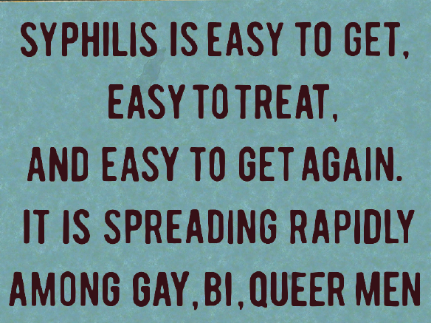
Syphilis is an infection caused by a bacteria called Treponema pallidum. It is spread through contact with a syphilis sore (also called a “chancre”), by condomless anal, oral and front hole sex or even deep kissing. Syphilis cases have increased significantly in every major Canadian City among gay, bi and queer men in recent years.
Getting syphilis again once you’ve had it is common. Having syphilis once doesn’t give you any immunity towards getting it again. Notifying your sexual partners to get tested after you have been treated is important to avoid re-infection.
Using a condom will reduce your risk of getting syphilis again in the future. Getting tested regularly will make sure that if you do get it again, you can be treated as soon as possible.
Syphilis Stages
Syphilis can be identified in several stages:
- Primary Stage – A chancre appears on your cock, ass, fronthole or mouth. The sore is painless and can be hidden on the underside of your tongue or in your ass. You might not notice it.
- Secondary Stage – A body rash develops 2 – 12 weeks later. The rash is not usually itchy and can be so faint you don’t notice it. You may develop flu-like symptoms such as a sore throat, fever and fatigue.
- Latent Stage – The sore and rash go away. There are no visible symptoms, but syphilis is still present.
- Tertiary Stage – The bacteria affect the brain (neurosyphilis), cognition, sensory organs, heart, and blood vessels. Complications, including brain damage and death may occur after many years if left untreated.
Syphilis Treatment
The simplest and most effective treatment for the early stages of syphilis is a shot of penicillin in the butt. Since penicillin allergies are common, alternative antibiotic treatments such as doxycycline and azithromycin may be used.
After treatment, your body requires time to recover. Even if you feel better, there may still be syphilis bacteria in your body, so it’s important to test again to ensure the treatment worked fully. It is recommended you get tested three, six and twelve months after treatment.
It may take up to a week for your body to clear the infection once you’ve been treated, so it’s important to take a break from sex to avoid giving syphilis to others. If you have regular partners, make sure everyone gets treated, otherwise you can re-infect each other.
If you’ve had syphilis in the past and test for it again, notify your healthcare provider of your past diagnosis. False-positives are common: once you’ve had syphilis, anti-bodies can remain in your body that are detectable by certain tests. If you have previously tested positive for syphilis and get a Serological Test for Syphilis Enzyme Immunoassay (STS-EIA), or Treponema Pallidum Particle Agglutination Assay (TPPA), these will likely test positive for life because they detect syphilis-specific antibodies. Polymerase Chain Reaction (PCR) tests and Rapid Plasma Reagin (RPR) tests can determine if you’ve been infected again with syphilis.
Getting Tested
Syphilis is common and spreads easily, so make syphilis testing a regular part of your health checkup. The test is confirmed with a blood test or the chancre can be directly swabbed if it’s still active. For a list of sexual health clinics providing services during the ongoing COVID-19 pandemic please visit Toronto Sexual Health Clinics.
Get tested…
- Right away when you have symptoms
- Once a year if you have a small number of sexual partners
- Once every 3 months if you have many sexual partners
If you are diagnosed with syphilis, we recommend also getting tested for HIV. Having syphilis may increase your chances of getting HIV because having a sore or break in the skin, such as a chancre, may allow HIV to more easily enter your body.

HIV Positive?
If you’re living with HIV and undetectable, your treatment for syphilis is the same as someone who is HIV negative. If your HIV is untreated, however, you may require more rigorous treatment. For early stages, instead of one shot of penicillin, physicians might suggest a shot once a week for three weeks, or pills taken orally over two to four weeks.
If your CD4 count is under 350, you may be more susceptible to developing neurosyphilis. Neurosyphilis occurs in the third stage, when the bacteria affect the brain and central nervous system and can develop in people who are not treated. Neurosyphilis can lead to treatment complications and requires more and longer doses of penicillin to treat.
If syphilis advances to neurosyphilis, penicillin therapy for ten to fourteen days is recommended.
Making the Call
Asking others about their recent STI tests may help avoid any inconveniences like having to get treatment or abstain from sex. It also shows that you’re invested in your own and your partner’s mutual sexual health. Here are some tips while having this conversation.
- Ask about recent STI tests before things get hot and heavy! It might kill the mood to ask in the middle of sex, so ask before the date either over text or over the phone.
- Avoid asking partner’s if they’re “clean” or “DDF” (disease and drug free). This type of language is stigmatizing.
- Consider asking folk how many partners they’ve had since they were last tested. Some people may have had multiple partners since their last test.
- Asking if someone’s on PrEP or if they are Undetectable can be a great way to initiate a conversation about recent STI tests.
Getting tested, knowing your STI status and telling your partners of positive tests are essential strategies to support not only your own sexual health but the sexual health of the community in which we live and play.
It is recommended to inform your partners of a positive test within the past three months for primary stage syphilis; within six months for secondary stage; and within one year for early latent stage. If your syphilis has advanced further, any and all long-term partners should be notified.
We also recognize that doing the right thing and talking to your partner(s) can be, well, awkward – so we recommend using TellYourPartner.org. This website allows you to enter the phone numbers of your partners, and it will contact them without you having to directly contact anyone. The text sent by TellYourPartner tells the person they may have been exposed to an STI and recommends they get tested. All of this is done completely anonymously and instantly. Visit TellYourPartner.org to learn more or to use the service for free.
If you’ve been notified that you have recently been in contact with someone who has syphilis, don’t freak out. Receiving a notification isn’t a guarantee that you’ve acquired an sexually transmitted infection (STI).
- Remember that STIs happen! Anyone who is sexually active can be exposed to them at some point.
- Remember that syphilis is entirely curable. With testing and early treatment, syphilis will not cause any long-term effects.
- Book an appointment with a healthcare provider or visit a sexual health clinic as soon as you can. If you have a confirmed exposure, you will likely be given antibiotics as a precautionary measure.
- Avoid sexual contact with others until you have completed the course of antibiotic treatment as set by your doctor (usually 7-14 days).
- Contact us at onlineoutreach@actoronto.org or 416-340-2437 if you need help with booking an appointment at a clinic or need more information about syphilis.
Check out the link below for a list of sexual health clinics in Toronto where you can get tested and treated:
ACT is committed to the health and well-being of all cis and trans gay, bi, and queer (GBQ) men, regardless of their HIV status. We have a range of Group Programs for gay men that address issues related to depression, anxiety, substance use and body image, as well as programs for younger GBQ men that help them build resilience and community. We offer mental health counselling at ACT offices and in the community. Our staff are also trained to develop and deliver sexual health Outreach and Community Education programs.
Each year, ACT has produces resources that address issues pertaining to gay men’s health. Here’s what we have produced lately:
- CATIE: Syphilis
- CDC Syphilis Factsheet
- Hep C and Sex for Gay Bi and Queer Guys
- Travelling with Prescribed Medication
- My Sex Life: info for young poz people
- BDSM: safer kinky sex
- Staying Off Crystal
One of ACT’s national partners has made these resources and others available to order. Find them at CATIE.ca
* We have chosen to use the term “gay” recognizing that this term may not resonate with all gay/bi/queer/2 Spirit men (including queer trans men). Our objective is simplicity of language and we recognize that our services and service networks must be equally skilled at being relevant and accessible to all men who have sex with men, regardless of how they understand their sexuality in relation to their core identity.